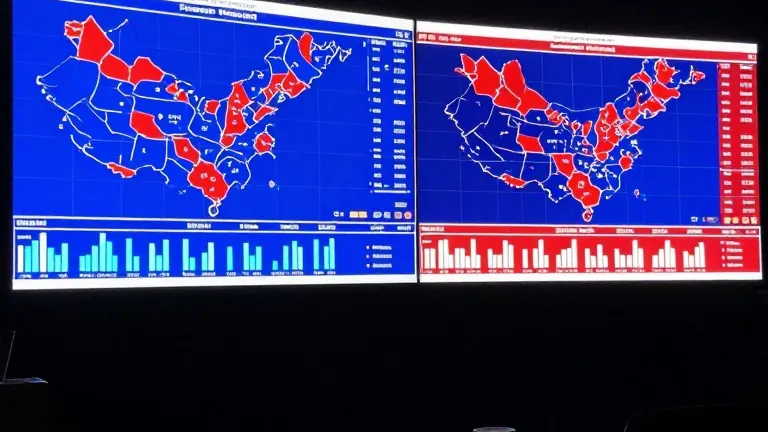
Midterm stakes rise as Supreme Court tackles preschool funding dispute
Voters will choose all House members and one-third of the Senate on Tuesday, while justices hear arguments on whether excluding a Catholic school from state funding violates religious freedom laws.
By Kenji Garnier ·
The central tension of this week pits the nation's electorate against the federal judiciary. Americans will cast ballots on Tuesday, November 3, for all 435 seats in the House of Representatives and 35 seats in the Senate. Simultaneously, the Supreme Court will hear arguments in a case that could reshape how states fund religious education.
The outcome of the midterms will determine which party controls Congress for the final two years of President Donald Trump’s second term. Republicans aim to retain their majority in both chambers. Democrats are attempting to flip both houses to blue. Governor's races are also on the ballot in 36 states, adding another layer to the political contest.
Analysts are focusing on three states where Senate races remain extremely close. Texas, Michigan, and Alaska are currently classified as toss-ups in the latest polling data. These results will likely decide which party holds the balance of power in the upper chamber after Election Day.
While voters head to the polls, the Supreme Court begins its November oral argument session on November 2. The court is scheduled to hold seven hours of arguments over five days, concluding on November 10. The most watched case in this session is St. Mary Catholic Parish v. Roy.
The case centers on a Colorado dispute involving a Catholic preschool. The school was excluded from a universal preschool program. The court will consider whether this exclusion constitutes a form of religious discrimination. Arguments in the case are set for Tuesday, November 3, the same day voters cast their ballots for the federal government.
The juxtaposition of the two events highlights the competing priorities of the American legal and political systems. One branch decides who writes the laws for the next two years, while the other interprets the constitutional limits on how those laws are applied to religious institutions.
Source: WCJB