Hundreds cross into Ukraine as US-brokered truce opens Oleshky exit
A four-hour evacuation window on Saturday allowed residents of the occupied city to reach Chernihiv, ending years of isolation behind Russian lines.
By Elena Svoboda ·
Olha stepped off a coach in the Ukrainian region of Chernihiv, her dog and immediate family beside her. Her husband, Viacheslav, described the transition from their home in Oleshky with a single phrase: they had come back from hell. The couple was part of a large group of residents who crossed into northern Ukraine on Saturday via Belarus, reuniting with relatives they had not seen for years. This movement marks the first mass exodus from the city since Russia seized it in the early days of its full-scale invasion in February 2022.
The city is geographically trapped between the Dnipro River on one side and Russian military positions on the other. For the past four years, residents have lived under constant threat. Olha described the recent weeks as a time of intense danger, where the couple attempted to cross minefields to find food as supplies ran out. She recalled seeing people step on mines, resulting in deaths and severe injuries, all in an effort to survive. Those too afraid to venture out relied on cooking garden weeds to stay alive.
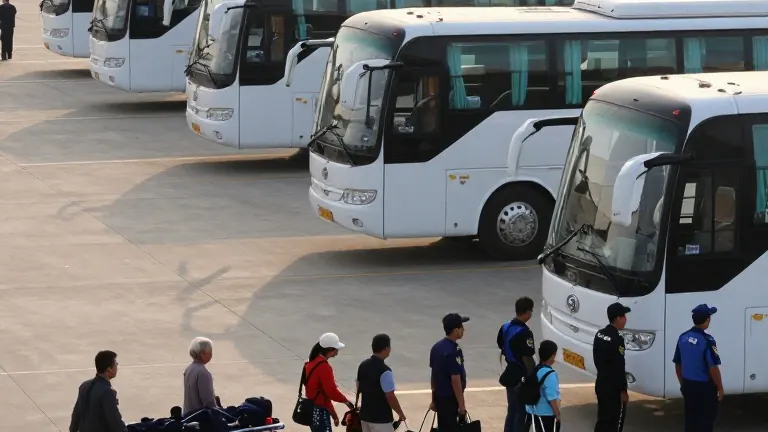
The opportunity to leave arrived earlier this week with a humanitarian ceasefire brokered by US First Lady Melania Trump. The truce took effect in the Kherson region, providing the first sustained period of peace in the area in four years. Authorities established a specific four-hour window on Friday for residents to exit. A convoy of 25 buses was deployed to transport up to 750 people, while ambulances were staged to assist those with limited mobility.
Before the evacuation, an estimated 6,000 people, including 200 children, remained in Oleshky and its surrounding areas, with 1,700 individuals in the city center. The route to safety involved traveling through Russian-occupied territory to southern Russia, followed by a flight to Belarus. The evacuees then arrived by bus at a military facility in Chernihiv on Saturday. The journey was physically taxing for many, with some elderly residents so weak they had to be carried on stretchers across the tarmac.
Emotional reunions marked the arrival of the first groups. Mykhailo Palii was greeted by his daughters, Dasha and Anya, who sprinted across the tarmac after believing they might never see him again. Palii had kept many details of their hardship secret to avoid worrying them, but he revealed that a drone attack had blown a hole into their bathroom. Missile strikes and drone attacks had become a routine part of life in the city.
Other evacuees had lost everything to the conflict. Tetiana and Volodymyr arrived carrying a cat, noting that their home had burned down three years ago. They had lived in an abandoned neighbor's house since that loss. Tetiana stated that leaving was an easy decision because they had no immediate relatives in the city and their children were married and living elsewhere. For them, the primary regret was not staying too long, but rather the loss of their home.
Those who escaped now face the immediate task of determining where to go next. Olha noted that her family has no relatives elsewhere in Ukraine, so they will stay with acquaintances for an extended period while they rebuild. Palii said he would seek work in physical labor, ranging from digging and planting to demolition. Olha expressed confidence in their resilience, stating that if they survived the conditions in Oleshky, they would manage to survive in their new location as well.
The departure of these residents leaves many others behind in Oleshky. Olha expressed concern for those remaining under the same difficult conditions. The humanitarian pause has provided a clear path out for hundreds, but the full extent of the population still trapped in the city remains a central concern for aid groups and families on both sides of the border.
Source: BBC News