Democrats Face a 68% Turnout Hurdle in Michigan to Retain Senate Control
With independent support and young voter margins serving as critical bellwethers, the path to congressional control hinges on specific county-level performance in key states.
By Kenji Garnier ·

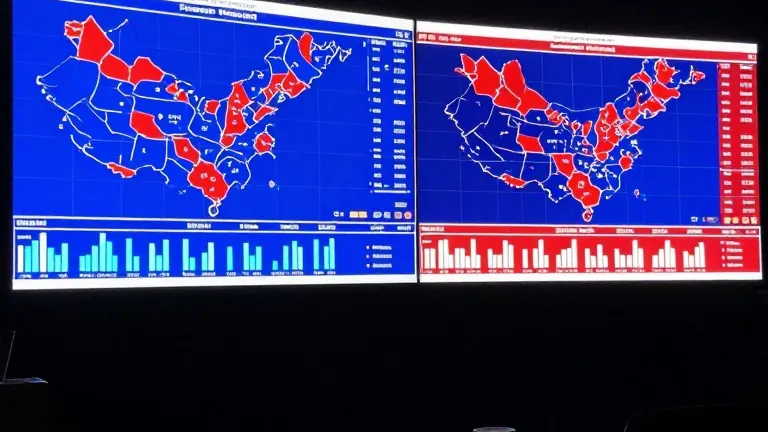
During the Trump era, Democrats have historically required at least 68% of the vote in Wayne County, Michigan, to secure a statewide victory. This threshold represents a strict benchmark for Abdul El-Sayed, the Democratic challenger in the Michigan Senate race. His ability to reach or exceed that figure in and around Detroit will determine whether the party retains control of the U.S. Senate or cedes it to the Republicans.
The stakes for the Senate are tied directly to the outcome in Michigan. If Republicans flip the seat, the number of Democratic seats they must win in other states rises from four to five. In recent cycles, El-Sayed has struggled in this specific demographic area. While Senator Elissa Slotkin managed a win in 2024 with a 63% share in Wayne County by overperforming in suburbs, El-Sayed lacks that same suburban advantage. The data shows a clear pattern: candidates who fell below the 68% mark in Wayne County, such as Kamala Harris in 2024 and Hillary Clinton in 2016, lost their statewide races.
Beyond Michigan, early results from Indiana and Kentucky will provide the first signals of Republican turnout. These states are expected to report House race results in the 6 p.m. Eastern Time hour. Watchers will look at Indiana’s 5th District and Kentucky’s 6th District, both held by Republicans. If these races appear close or tilt toward Democrats, it suggests low turnout among Republican base voters. Florida will offer additional data in the 7 p.m. Eastern Time hour, specifically regarding the Latino vote in the 27th District, which Donald Trump won by double digits in the previous cycle.
The margin among young voters, aged 18 to 29, remains a decisive factor for the Democrats. Turnout in this group drops sharply from presidential to midterm elections, falling from 43% to 21% on average. Since 2000, Democrats have fared well when they win this demographic by more than 20 points. The only exception was 2022, where a 28-point margin helped limit Republican gains in the House, even as the party lost nine seats.
In Texas, Democrat James Talarico faces a long-shot bid against a party that has not won a statewide office since 1994. His path to victory relies on two specific variables: the vote differential between Republican Governor Greg Abbott and Attorney General Ken Paxton, and the Latino vote in South Texas. In 2018, Ted Cruz won by more than 200,000 votes despite losing to Abbott by 400,000. Talarico needs the gap between Abbott and Paxton to exceed that 400,000 figure. Additionally, he must outperform Beto O’Rourke’s 2018 numbers in key Latino counties, including Cameron, Hidalgo, Webb, and Nueces.
Independent voters also play a pivotal role in the national tally. Republicans have generally succeeded in the last decade when securing at least 46% of independent support. In contrast, Mitt Romney won 55% of independents in 2012 yet lost the presidency. The political realignment of the past few years has made this threshold more accurate than in previous decades.
Exit polls on party identification will reveal the current strength of the Democratic base. The share of voters identifying as Democrats hit a low of 31% in 2024, down from 39% in 2010. To compete effectively, Democrats must reverse this trend. Recent polling indicates high levels of enthusiasm among Democrats, driven largely by opposition to President Trump, with 53% of likely voters strongly disapproving of his performance. This dissatisfaction may serve as a unifying force for the party on election night.
The Michigan Senate race and the contest for Michigan’s 7th Congressional District will also serve as tests for progressive candidates in purple districts. The outcomes in these races will provide early indicators for the 2028 presidential primary. The performance of these candidates will help define the ideological direction of the American left for the coming years.
Source: KIOS-FM